
Introduction

What is Sortition?
Sortition is the process of using democratic lotteries for governance.
What is a Democratic Lottery?
A democratic lottery is a method to construct a democratic governing body. This method of democracy has been practiced historically all over the world, including in Ancient Athens and Renaissance era Italy. Today, many world governments now use democratic lotteries to assemble Citizens' Assemblies to help decide on the toughest decisions government must make. Topics debated include Climate Change, abortion, gay marriage, election reform, and others. These Citizens' Assemblies have gained a reputation of being able to cut through partisan divides and come to consensus on future-focused decisions.
The most familiar example of democratic lotteries is found in American jury duty, where everyday Americans are tasked with decision making in our justice system.
Democratic lotteries are otherwise known as sortition or lottocracy.
Why Lotteries?
Imagine a Congress that actually looks like America. It's filled with nurses, farmers, engineers, waitresses, teachers, accountants, pastors, soldiers, stay-at-home-parents, and retirees. They are conservatives, liberals, and moderates from all parts of the country and all walks of life. Democratic lotteries are the only way to achieve such a Congress. Democratic lotteries guarantee a Congress that is descriptively representative of the American public.
Learn more about citizens’ assemblies and democratic lotteries here.
Videos
Books
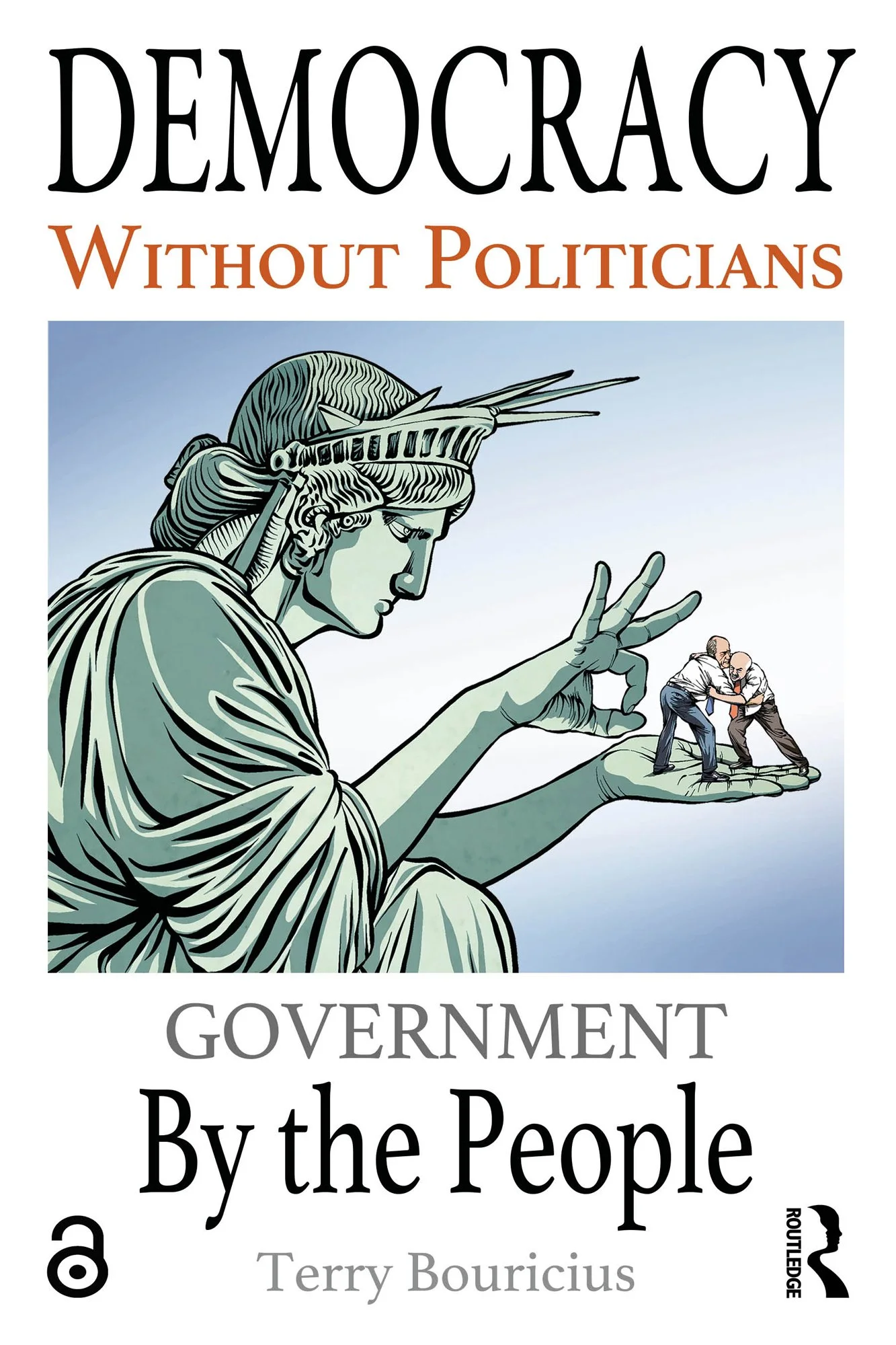
Democracy Without Politicians by Terry Bouricius
This book explains how electoral “democracy” is inherently undemocratic—enshrining rule by elites rather than popular self-rule—and argues that sortition is a superior democratic alternative.
Making the case that representative government can function better without the exclusive reliance on elections, the author sets out the problems with modern elections, the inadequacies of the commonly proposed reforms, and examines the cognitive biases, detrimental psychological effects and societal polarization that elections exacerbate. The book further delves into the progression of democracy and sortition in ancient Greece, and the abandonment of sortition in the framing of the American Constitution and French Republic. Finally, it sets out both immediate and long-term prospects for renewing democracy through the use of multi-body sortition.
Written by a former elected politician and policy analyst, this book will be of interest to students, researchers and citizens interested in comprehensive democracy reform.
Available for free download here!

Down With Elections! by Campbell Wallace
For two hundred years, we have assumed that free elections bring democracy and good government. The media, politicians and some political scientists tell us so, but is this true? The governments we elect fail to effectively tackle urgent problems such as climate change and environmental degradation, even though most people want immediate action. Politicians blatantly disregard facts, corruption is widespread, and the influence of powerful lobbies and wealthy interests on politics is notorious. Although we call our system “representative democracy” in fact it is neither. Yet in spite of their obvious failings we continue, with a sort of collective blindness, to put our faith in elections – and to complain afterwards at the results. After listing in detail the failings of elections, this book presents a feasible alternative: sortition, (choice by lot), which, when used with suitable institutions, provides a much fairer representation than we see at present, giving a parliament which automatically takes into account the wishes of all citizens. In the model proposed any citizen may make proposals for laws, and the use of policy committees to do background research permits fair, informed and intelligent decisions even on complicated technical questions. The author shows how such a parliament can interact with the administration and the judiciary, gives examples of the legislature in action and shows the advantages of this system in eliminating corruption, incoherent policies, and the dominance of money, ideology, and crude, “tribal” loyalties among voters.We need reform, and this is the reform that will make other reforms possible.
“Excellent. Well thought through, and well-argued.”—Terrill Bouricius, former Vermont Senator
“Innovative, thoughtful, and well-written. I highly recommend it”—David Schecter, Political researcher
“Punchy, concise, practical and clear. Wonderfully readable and non-academic”—Iain Walker, New Democracy Foundation

Can Deliberation Cure the Ills of Democracy by James S. Fishkin
In our modern world of propaganda, social media enclaves, misinformation, and manipulation, the connection between 'the will of the people' and political action has broken down, political divisions are becoming increasingly intractable, and democracies are growing ever more ungovernable. Democracy is in crisis.
In Can Deliberation Cure the Ills of Democracy?, James S. Fishkin argues that deliberative democracy can have surprisingly positive effects on all of these problems and charts a unique path to fixing them with his method of Deliberative Polling. After decades of applying and perfecting the methods of deliberative democracy in countries all over the world, this book synthesizes the results of 150 applications and shows how the method can be applied to resolve many of democracy's seemingly intractable challenges. It can clarify the public will and depolarize our divisions. It can be applied to major national and local decisions, it can spread in schools, it can be used by corporations, it can make for more meaningful ballot propositions, it can help reform the primary system, it can scale with technology, and most importantly, it can help reform electoral democracy, help preserve the guardrails that protect the electoral process, and provide key policy inputs in almost every contested issue area from climate change to the rights of minorities.
Fishkin demonstrates that deliberative democracy is a practical solution if applied widely and lays out a vision for how to combine elections with deliberation to build a more deliberative society, one that cures our extreme partisanship and leads to substantive dialogues that foster mutual respect and more engaged voters. Deliberation provides a story of thoughtful empowerment and democratic reform, strengthening but not replacing our current institutions.
Also available as an audiobook on Spotify
Frequently Asked Questions
-
By using democratic lotteries (aka sortition) to select members for citizens’ assemblies. This way, the voice of the people is directly represented. Elections, by contrast, tend to be dominated by the wealthy and well-connected.
-
Under sortititon, average people aren’t simply pulled off the street and put in charge of important government functions. Rather, a large group (usually 30-100) are brought together to hear from experts, do their own research, and deliberate among themselves to reach informed conclusions. There have already been over 1000 of these assemblies globally, and they produce high quality results. The reports created by these assemblies are publicly available, so you can see the quality for yourself!
-
Yes! Voters are still an important part of the process. Right now, voters only get to choose between politicians chosen by the big political parties. Even when they vote on ballot measures, they only get to vote on ones that could pass through the extremely expensive signature-gathering process to get on the ballot, a process dominated by special interest groups with lots of money. Under sortition, voters will get to weigh in on ideas put forth by assemblies of regular citizens such as themselves.
Voters will be an important part of the system of checks and balances. If assemblies propose a bad idea, voters can vote it down.
-
Of course expertise is important, but we believe that experts should be on tap, not on top! Experts don’t always get things right, and often disagree with one another. That’s why assemblies hear from many different experts and carefully weigh the information before coming to a decision.
Sometimes experts need to be directly appointed to a role, like judges, district attorneys, or the leaders of government agencies. Here too, assemblies can help, by vetting and interviewing the candidates for these roles to make sure they serve the public good, rather than special interests or partisan political parties.
-
They have tried, but democratic lotteries are hard to manipulate! No one knows who will be selected ahead of time, so it’s hard for special interest groups to offer deals in exchange for cooperation. There have been cases where manipulation was attempted. In France, government officials and corporate lobbyists tried to approach assembly delegates, but they failed to get any traction, and their attempts were quickly revealed.
Because assemblies tend to be large, and usually require supermajorities in order to pass their proposals, it’s very hard to get away with bribing or influencing them. Only one person has to snitch for the scheme to be exposed, making it extremely risky to attempt.